Notes from the Field: The Making of
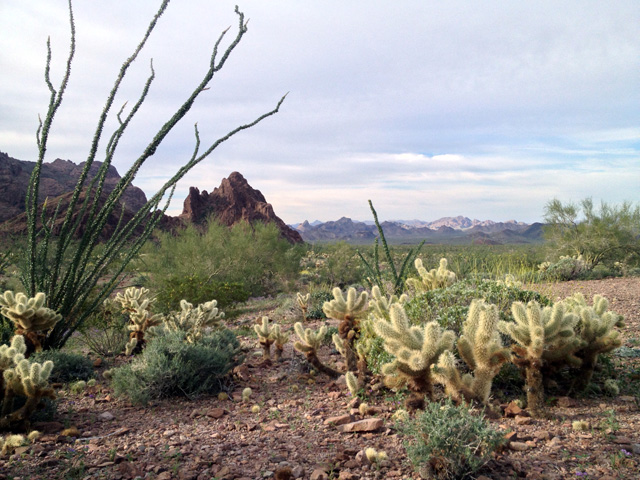
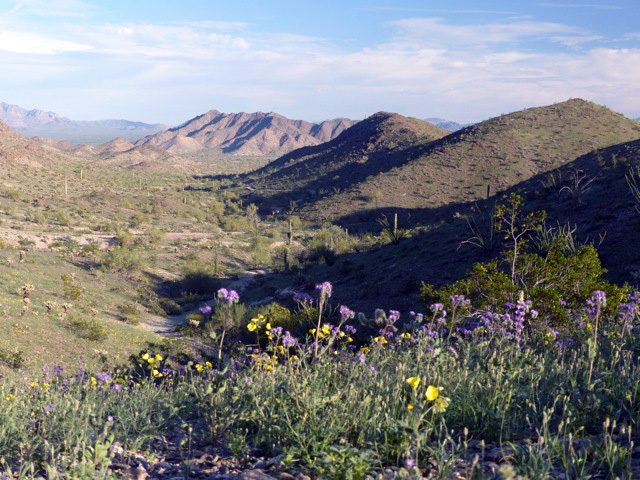
OurWild - Quartzsite >>THURSDAY I pop the hatchback of the rental vehicle and load my gear in the back: small suitcase of clothes and my laptop, plastic bin of A-V equipment, field day pack. It is dawn on a Thursday in March in Ehrenburg, Arizona—on the Colorado River and California-Arizona border. The softly increasing light, the birds awakening in song, that chill in the desert air while the sun warms one’s skin. I sometimes make like a roadrunner and turn my back full towards the sun, soaking up the warmth to loosen my bones and flesh from their overnight cold contractions Jennifer Dickson, our Southwest Communications colleague, walks out of the Best Western, across the parking lot, and drops her gear in the back of the van as well. We’re here for a TWS “Our Wild” field video/photo-shoot. We pull out onto I-10 East at milepost 4 to join with our colleague and photographer Mason Cummings, who has spent the night in the field. The sunrise we are driving towards lights a series of rolling cloud lines in vibrant shades from rose to tangerine. But only for a very few minutes; beauty can be fleeting. If we’d left even 15 minutes later we would have missed this glorious “welcome to a day in Arizona”—as the sun rises just a degree or two above the horizon its light touches the same clouds from a slightly different angle and the clouds fade into “typical” morning tones of muted purples and blues. An OurWild shoot is one element of a storytelling project TWS has created to share individuals’ personal values and connections to our great outdoors. The shoot is in the middle of the process. Before, comes identifying good and willing subjects, coordinating schedules, finding the narrative and its fit with the others. After, comes editing, crafting the story, publishing the presentation and promoting it to the world. The shoot is when we get the images—still and video—and the audio that will be the content we work with. As you might imagine, it’s an expensive proposition and one we don’t fully control—there’s the weather cooperating, technical issues, getting to remote locations and out again, the “talent” being healthy and relaxed. As they say, “tape is cheap”, but re-shoots are not. Fortunately, today looks like we’ll be good on weather. The morning’s clouds hold no rain and begin to dissipate as the hours progress. +++ We came out yesterday from Tucson—where I live and where one of Arizona’s two main airports is. It was a long drive; several hours of blacktop and desert. >>WEDNESDAY We rolled into Quartzsite and made for the Kofa National Wildlife Refuge south of town. Driving from Tucson to Quartzsite is about like driving from DC to Pittsburgh. Or Denver to Grand Junction. It’s a bit of a drive. We wanted to get out on the Kofa before sunset to get some good photos. The Kofa NWR was first established as a game preserve by President Theodore Roosevelt in 1939, primarily to benefit desert bighorn sheep. It had previously been mined for gold and silver. The name “Kofa” is a contraction of the name of the largest mine: the King OF Arizona mine. In 1976 it became a National Wildlife Refuge, and in 1990, 82% of its 665,400 acres became designated Wilderness. Kofa NWR is the second-largest Refuge in the lower 48 states and the second-largest Wilderness area in Arizona. Yesterday afternoon as we drove towards Kofa Queen Canyon, the land was amazingly green. This is a rare thing for southern Arizona. I love the typical dark blue sky against brown and purple rock with smatterings of cactus. But in spring, after a bit of rain, the desert pops with color: the green leafing-out of ocotillo cactus, palo verde and ironwood trees, and the foliage of wildflowers. The greens run from deep forest green to a light grey-green sage color. And on that canvas of foliage: the daubs of yellow, orange, melon, pink, and white that are the flowers of brittlebrush, globemallows, trixis. A quick expression of life and color that a month before or a month after would be invisible. Monet would have liked spring in the deserts of Arizona.
At the mouth of Kofa Queen Canyon we got out of the vehicle and looked about in awe. Mason began photographing. He decided to camp there to take advantage of sunset and sunrise light and to perhaps get some starlight shots. Free from the car, we three had some time to ourselves as we wandered about admiring views, focusing on details of the land, feeling the breeze, smelling the scents and hearing the natural sounds and rhythms that make wilderness so special and intimate. It’s moments like these when the rush-rush business of the day can fall away for a short time and make space for larger thoughts. I’d been to this exact spot several times before. I came to know Kofa a bit because I had been dating the Refuge biologist; she’d brought me to places like this and taught me about the area. We’ve since parted, and I wonder if the next truck we see will be her’s. I can’t help thinking about that relationship. I believe that landscapes hold pieces of us and our memories; a supra-physical combining of place and experience into more than memory, into an intertwined imprinting of landscape and us; a “connecting” in a literal sense of our past-present-future as individuals and groups through place. Earlier today we’d received the horribly tragic news that one of our colleagues, Megan Dickey, had died. I know Jen and Mason worked in our Denver office with Megan and I know the news is weighing heavily on them. We’ve talked OF it during the day but not ABOUT it. And I’m rather deficient at grieving with others or of showing my sympathies and support in situations like this. The forced reminder of our mortality puts me in a state of existential denial or avoidance. As I walked about the beautifully blooming desert I thought about the only time I met Megan. It was a few months ago when I was in our Denver office for a meeting. As I was leaving to catch my flight home I was saying goodbyes to everyone there. I saw a young woman working in an office by the door and didn’t recognize her. So I politely interrupted her and introduced myself. She was Megan. I remember an exuberant energy from her, a big smile, and a too-short chat of introduction that ended with intentions to talk more and work together in the future. Standing in an ethereal wildflower bloom I thought of that afternoon in Denver. How I was happy I had interrupted Megan; and how “see you next time” is a hope as much as a promise. And now the rocks and landscape of Kofa Queen Canyon hold another memory, another piece of me—as sure as petroglyphs and flowers. And in some way—if only through tragic timing and the memories of Jen, Mason and me—this clearing above the bajada with granite surrounding, Kofa Queen Canyon now holds something of Megan. A place maybe she’d never been; until now. +++ Jen and I helped Mason unload his camping gear and camera equipment and we all planned to meet back there in the morning—Jen and I staying in town for the evening, Mason joining us for night two. Well, by “in town” I mean Ehrenburgh, Arizona, about ten miles west of Quartzsite. We’d looked to stay in Quartzsite but the only motel there had horrible Yelp! reviews—including several recent guests who posted photos of the bedbug bites they received. So, Ehrenburgh it is. We checked in to our rooms then drove over to Blythe, California, to get a quick meal. Sitting outside a local BBQ place we got talking. The more we talked, the more it seemed that getting Jen and Mason back home to be with friends and family grieving Megan was important. We did some googling and quick calculations and figured we could wrap the next day’s shoot at sunset and still be able to get them to Phoenix Sky Harbor airport for a late-flight for Jen and a next-morning flight for Mason. We texted Mason—amazingly, he had service—and hatched the plan. +++ >>(Back to) THURSDAY After the beautiful fleeting sunrise we are back out on Kofa to get Mason. He reports a beautiful night of stars and natural sounds. We load his gear in the van with ours and head into Quartzsite.
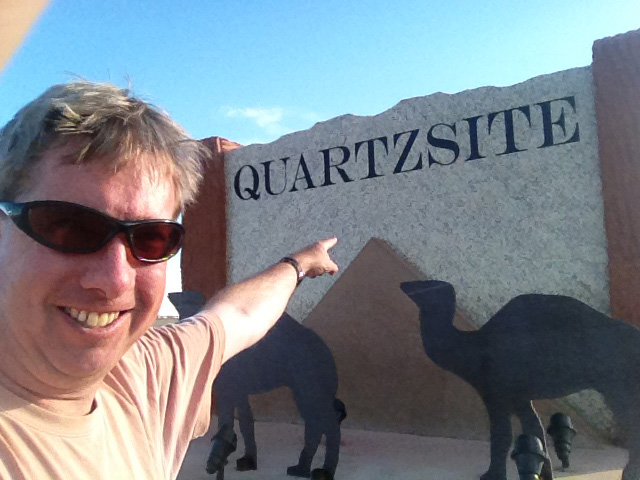
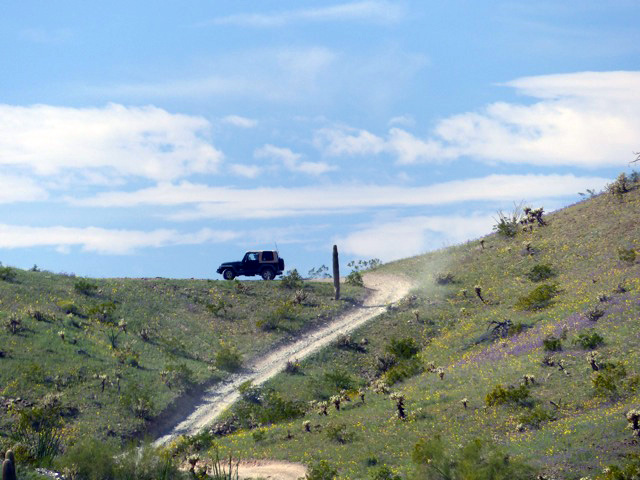
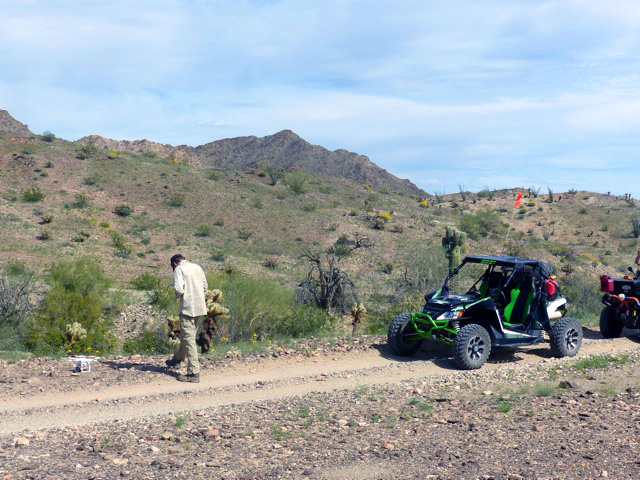
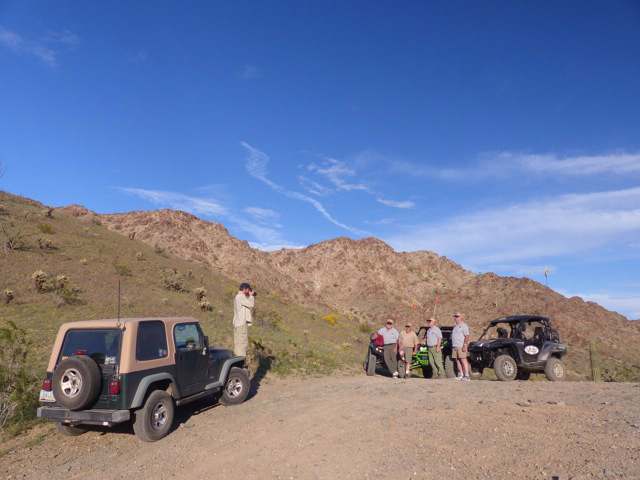
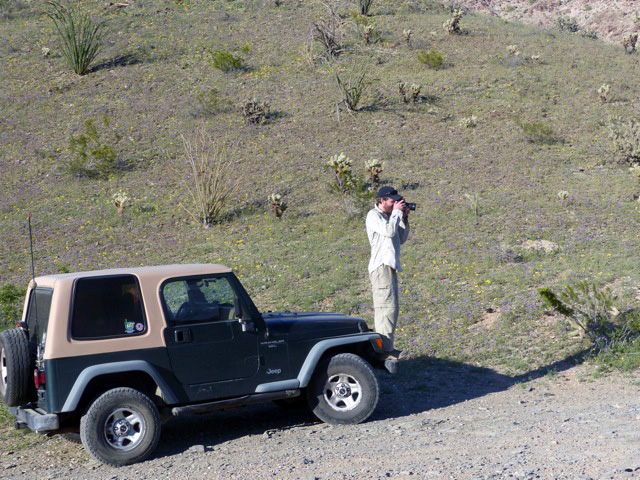
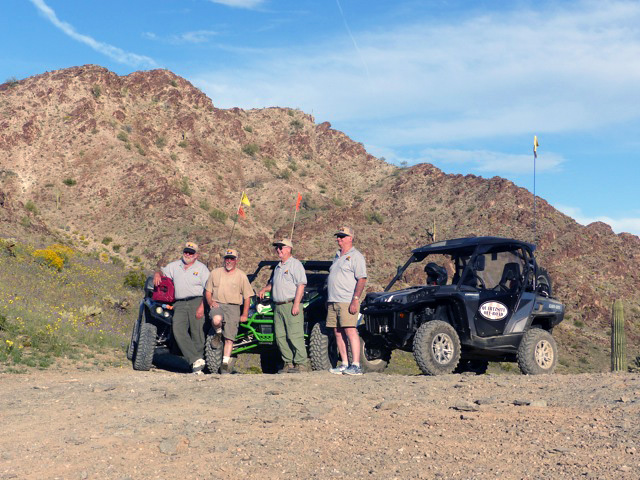
Quartzsite, Arizona, is a quirky crossroads town—where Interstate 10 east/west meets Arizona State Route 95 north/south. It’s been a mining town, a training area for desert warfare during World War Two, and is now primarily a retiree warm-weather winter haven. In the summer months, when the temperatures are routinely over 110 degrees, the population of Quartzsite is about 3,700. In the cooler winter months the population exponentially increases to about 250,000 with the annual migration of snowbirds—Canadians from British Columbia and Alberta, and Americans from the Pacific Northwest and upper Midwest—older retirees. Like many migrations, they arrive a few at a time at first, then en masse—a post-holiday fallout event of RVs towing jeeps and toy haulers. Seasonal villages of RVs popping up in RV parks around town and on patches of BLM land—like a Mad Max-meets-Burning Man-meets football tailgate party—but without the violence, nudity, or keggers. Sometimes I think this is our future: seasonal RV camps following the temperate weather, fueled by gasoline and bottled water rather than prey availability and running streams. We are to meet our filming subjects at 11:00am so we have some time to kill. We get coffee and talk through the day’s shoot—how we’ll work it, what is absolutely necessary to capture, times and distances and such. We decide an A/V adapter for the mic cable to Mason’s camera would be nice to have and there is a Radio Shack nearby. We run over and they have one that looks like it will work. The Radio Shack is sparse and the manager tells us they’d been told they’re likely to close. Amazon is convenient for a lot of things, but when you need a mini-HDMI-to-microjack plug adapter and you need it now, Radio Shack has always been the go-to. +++ Let me take a moment now to talk about the OurWild shoot we were there to do. I know, you probably thought this would be on page one. Go with it, it’s field work—everything always takes longer than you expect. We’re going to meet JC, Bruce, Ron, and Doug. These guys like to ride OHVs and they like the desert. They ride responsibly and they also value conservation. We think their story will reach people our usual messaging does not. JC is the ringleader. He and I met serving together on the BLM’s Resource Advisory Council (RAC) for Arizona. JC is a recreation representative and I’m a conservation representative. JC is an affable, smart, get-things-done guy. A retired Civil Engineer for the U.S. Army Corps of Engineers, he has a farm in Kentucky and winters in Bouse, Arizona—not far from Quartzsite. We got talking over lunch at one of the RAC meetings and we got along. He called me a bit ago about the Ten West Link transmission line that we want to see stay away from Kofa. JC wants that too and also wants to keep it out of Johnson Canyon, a small low desert canyon nearby. He asked if TWS could help with that. I’d come out several months ago and he took me to see Johnson Canyon in his Razor with some friends. It’s a beautiful little canyon—we are blessed to have so many in Arizona. JC and his friends are working with local authorities and Arizona State Parks to create a long loop drive for OHVs, using existing BLM travel routes and some state roads. These guys aren’t yahoo-ing around, tearing up the desert. They’re older; they suffer some of the restrictions of age: joints, muscles, bones that don’t respond like they did decades ago. A three-day backpack is likely out. But they still love the scenery, the remoteness; and ATVs—on legal travel routes—are how they get there. (They also like peace and quiet. ATVs are anything but. I mentioned this to JC and he laughed. “I know!” he said, “and they’re selling to old people—we don’t want the hot-rod roar.” Tesla, take note.) On a previous visit to the RV park where the guys often start out, I noticed that there were mascots on some of the ATVs: a stuffed monkey in the grill, for example. I’m told there are “clubs”—the Monkey Brigade, in this case. JC belongs to the Bouse Ghost Riders. There are also the Sunriders, the Desert Riders, and others. No leathers, I don’t think, but this highlights another aspect for me: the ATV riding as social activity. The clubs meet, plan group rides; it’s how newcomers can find welcome and entree, it’s a binder in this transient community. While we were standing around in the “street” talking and slowly securing gear, another guy came out of his RV and strolled over, asking what’s up. They all know each other; the day’s stories are told, the gossip caught up on. These guys have twenty years on me and I flash back to my childhood—where a popped hood on a car in our suburban neighborhood would have had all the men gathering about offering help, “advice”, tools. Or even earlier to my years in a southwest Philadelphia row house—a community where no one had air-conditioning and in the summer families would sit on the front stoops as the evening began to cool. That sort of living situation encourages outdoor living, and in close quarters. While we were talking at the RV park that day I was listening to their stories. They were using different phrases than we (my colleagues and me in the conservation world) usually use, and they may enjoy the landscape by a different means than we usually do, but underneath they hold the same values we do: respect the land, value the openness and views, be responsible, this is a wonderful thing of America. I’d asked JC, “have we talked before about the State taking over federal public lands?” He said, “I don’t think we have. At least, I don’t know your position on it.” Before I could respond, he said—in a way that was honest rather than confrontational—“Not that I need to know. I think it’s a horrible idea.” I laughed and said “Good. I think it’s a horrible idea too.” JC said, “I’ll stump speech on that anytime.” I said, “Well, we might be able to give you a good stump.” +++ Now, Jen, Mason and I are sitting in a truckstop parking lot in Quartzsite waiting to meet up with JC and his friends. We pulled in and tanked up and we have about an hour to kill. Of course, we’re all immediately on our phones checking email, circling the trashcans by the van making calls—rocking the daily biz from the truckstop. Then, caught up for the moment with what we can do remotely, we transition to getting in the field mindset for the shoot. Mason finds our Radio Shack adapter is the right type, but the plastic housing is too big to get into the space we need it to go into. We look at each other and in rapid sequence agree: 1) this sucks; 2) let’s McGyver it. So we use my Swiss Army knife to pry open one end of the plastic housing and break it away. The adapter end is now hanging from loose wires so we grab some adhesive tape from the first aid kit in my pack and use that to secure the adapter and the wires. It fits now. We half-jokingly comment that “Other groups? They’d be like ‘oh, this doesn’t fit, we’ll have to reschedule the shoot.’ The Wilderness Society? We find ways to get it done.” Spend an hour in a truckstop parking lot and you start to notice some things. When we pulled off the Interstate there was a couple with a “homeless, anything helps” cardboard sign. This is an unfortunately-common sight in Arizona. The couple also had a dog with them. We can see them still from where we’re parked. We have a short and interesting discussion where we start feeling sorry for them and the dog and Jen notes that the dog—provided he’s fed—is probably loving it, that he’s outside and with his humans 24/7. Jen goes into the truckstop convenience store and buys water and dog food. She walks it over to the couple and the dog. Back in the van we watch a car stop—more dog food. Then another. Then the couple lines up the dog food deliveries in plain sight beside the road. A red Prius stops and a young guy gets out. We’re watching the silent movie from the van. Gesturing, heads nodding, glances at the bags of dog food. The young guy puts his dog food back in the Prius and pulls out bottled water and gatorade. Before he’s even out of sight the couple is drinking the gatorade, the dog pawing them and being petted. We have about twenty minutes more to wait. It occurs to me that we’re going to be in the field until dark. We have plenty of water and tea on ice in a cooler, and snacks in my pack. But I think maybe I should eat something more substantial. It’s not that I don’t know where my next meal is coming from—but I don’t, and it could be a while. As sometimes happens: good idea, poorly executed. I go into the truckstop convenience store. It’s mobbed. I scan down the cold drink cases and feel the same frustration I’ve felt in situations like this a hundred times: an entire wall of cold drinks, but few choices. Bad beers, a few bottled waters, and cases and cases of Day-Glo-colored HFC-syrupy drinks. No matter, water is good. Now for substance. Racks of candy and jerky. Up front, a Subway franchise, and a fried chicken franchise. Cool. A few chicken tenders—not so much to make me sluggish but enough to keep me going. It also has the shortest line. I missed that tell. I get my three-piece tenders with honey-mustard sauce. Everything comes with large-cut french fries. Like steak fries—wedges of potato the same size as the chicken tenders. Part of the price; fine. I look and see an open booth, right under a TV. “President”—give me a second to cough that out—Trump is on the TV. In Detroit, I think, promising everything to people who have lost much. The best I can do is sit with my back to the TV: I really should put earplugs in my daypack. I open my bag lunch and pull out a tender, dip it in the honey-mustard sauce, and take a bite. Man, this is some mushy flavorless chicken. Another bite. Hmmm. I inspect the piece. Looks like a fried tender. I spill the contents of the bag for a more thorough inspection. Three of one fried thing, three of some other fried thing. I take a bite from one of the “other” pieces. Hmmm. Maybe THIS one’s the chicken, a little firmer texture under the breading. Back and forth sans sauce. I think I can tell the fried potato from the fried chicken. I force down a few bites, the honey-mustard sauce making it bearable. It’s not just the worst fried chicken I’ve ever had, it’s very possibly the worst thing I’ve ever eaten. And I’m eating it while I hear Donald Trump behind me saying to believe him that things will soon be so great. I smile at this. +++ JC and his friends arrive right on time. They’re in the cashier line for some last-minute supplies of their own and JC calls to me as I’m headed out the door. Everyone’s here; check. Time to get back to work. We join up with their vehicles in a corner of the expanse of truckstop parking lot and make our introductions. JC has brought a few friends: there’s Ron, a retired sign technician and President of Bouse Ghost Riders who lives in Bouse, Arizona, year-round; Bruce, a retired charter bus driver from Idaho and now President of Arizona SunRiders; and Doug, a retired business owner who lives year-round in Quartzsite, a distinction few can claim. It’s already getting unseasonably warm and the truckstop is noisy, so after handshakes we decide to get on the road. There are plenty of vehicles so Jen and Mason go with Doug and Bruce and JC rides with me. Even a short bit of “truck time” helps folks get comfortable with each other quickly. We drive the short distance to Doug’s place, a few acres on the north side of town, to go over the plan for the afternoon and get JC’s interview recorded. At Doug’s we settle onto the porch in the shade. There are nice cactus and bougainvillea lining the porch and around the yard. The occasional call of woodpeckers and thrashers mixes with the warmth and stillness of the air to create a restful desert feeling. Mason puts a microphone on JC. We’re going to record an interview and edit it into the audio track for a video. The idea is to capture JC’s stories of how and why he values public lands and the outdoors. Jen has some prompting questions ready in case he gets nervous. Some people who are otherwise very eloquent can get tense when being recorded; others will keep talking for as long as the mic is on. It can be hard to know in advance. With good open-ended gentle questions from Jen, JC tells his story: the Kentucky drawl adding an element of wistfulness and calm to his words. He grew up on a farm where “the outdoors” was all around him and just outside the farmhouse door. His father worked for the National Park Service. He’s always enjoyed time in nature. As he’s gotten older he uses his ATV to access some beautiful scenery. He sees public lands as one of America’s great assets and defining features. He’s working with other ATV clubs to encourage a culture of responsibility and stewardship. The interview takes some time. While Jen steers the discussion and Mason monitors the audio levels, the rest of us try to stay quiet, not laugh or comment, and for me for some reason, to not look at JC. As if my staring at my shoes or looking at birds in the yard is any less odd than following the conversation. Finally, Jen breaks the tension with a last “are your friends going to give you a hard time for doing this?” and Ron, Doug, and Bruce nod vigorously “yes”, we all laugh, and it’s about time to head to the field for some videography and photography. But in that post-interview release of pent-up comments and thoughts, the guys start riffing off each other echoing JC’s themes with stories of their own. Ah, we should have kept the mics on! +++ When one watches a three-minute OurWild completed video on our site, the scenes, cutaways and storyline seem to flow effortlessly together. As if it was filmed in real time. As if the first take was always perfect. That’s due to the skills of pre-production planning, the camerapeople, the “talent”, and the editing and post-production. With a dose of luck for weather, light, timing, and locations added in. The business of MAKING video: long, repetitive, slow, careful. Particularly long and repetitive. A single five-second shot of someone walking down a trail is often the result of them walking down that trail—in both directions—over and over about a dozen times. The glamour of Hollywood. We start unloading the ATVs from the trailers. Close-ups of the ratchet tie-downs, the tread rails slapping to the ground, wheels beginning to turn. Not a dozen times, but enough. Then it’s engines start, load gear and people, and head out to the desert. +++ We go to a pretty little canyon in the Dome Rock Mountains on BLM-managed land northwest of Quartzsite. It’s not too far from Doug’s place, but it’s a little higher in elevation, a little more rugged terrain, and the single route we’re on takes us to a saddle with views into Kofa NWR to the east and California to the west. And around us: classic Sonoran Desert—in vibrant colors of greens, whites, yellows, and purples. The winter rains have been good: the desert has responded with brittlebush, verbena, yellowcups, fleabane, poppies. The green valley and colorful hillsides rising to tan and dark brown rock outcrops against a brilliant blue sky. We set up an establishing shot: JC and friends driving up the road to the saddle. It’s mid-day/early afternoon and the light is a bit harsh—as desert light often is—but the lack of long shadows has a way of enlarging the sense of openness, of vulnerability, of exposure, of the desert.
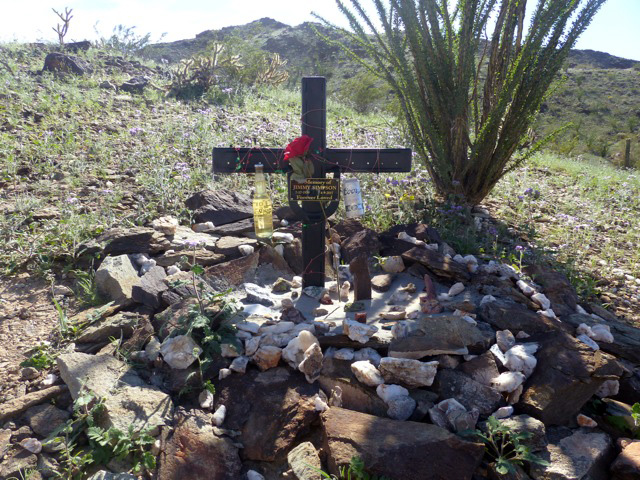
The guys have two-way radios and one with us at our set-up location relays direction from Mason to those riding: “Okay, turn around and come back, just like that.” “Wait there a minute for the dust to settle.” “Follow each other a little closer next time.” “Don’t follow so closely.” It’s warmed up a bit so in between takes those of us not busy with re-locating tripods or changing memory cards or batteries seek out the shady side of the trucks; often sitting by a wheel to keep the sun off of us. No more roadrunner pose to soak up the warmth; now be still in the shade like javelina. During one of these lulls and a snack break, I glance to the side and see a reflective glittering up the hill. I walk up and it’s a cross, with an “in memory of” plaque, a bottle of Corona, a horseshoe, a rose: a shrine. These sorts of memorials are common in Arizona—an artifact of Mexican Catholicism, I’m told. The folklore history is that they mark the location of a sudden death—so sudden that last rites could not be administered and so the deceased’s soul is in Purgatory, needing prayers from the living to gain entrance to Heaven. Many of these shrines are on roadsides. Historically, Apache raiding parties were the bringers of sudden death; now motor vehicle accidents. I’ve noticed variation in extravagance among shrines and think the custom may be evolving/morphing into remembrance—or a marker at a favorite place with artifacts of favorite activities.
It’s strange to see one in the backcountry. And today it reminds me that however focused we may be in a moment, there’re layers of engagement underneath, always. Thoughts slip in and out; no two people carrying the same context. We relocate for a different shot. We get a lot of shots. Mason has a “shot list” of content he wants—he’s envisioned the end-product and also knows that one of the best things to have in the editing suite is a lot of good B-roll to use for cutaways and covers. We are also opportunistic. When an idea hits, or a particular hillside catches attention, we adjust. This happens when moving from one semi-planned location to another. We crest a rise and starting down the other side the little dirt track slides below a gentle hillside covered in color. Wildflowers, grasses, ocotillos; a great backdrop. We unload and set-up the gear again. Here’s the shot we’re looking for: the guys driving slowly by and admiring the scenery.
Mason mics one of the two-way radios and patches it into the camera. Now, as they ride by, one says “look at that hillside of flowers!” Another replies “We’ve had great rains this year.” And a third chimes in “It’s so green!” About a dozen times. They’re good sports. One time maybe “SO green”, another time “So GREEN”. My job on this scene is to hold the boom mic (the “fuzzy mic” as Kate calls it when the windscreen is on). It’s a directional mic on a long telescoping pole. It’s used to get closer to the source of audio when wireless or other wired mics won’t do, or when you don’t want to see them in the shot. My job is to get the mic low beside the trail to capture the “crunch” of tires on dirt as they guys drive by. I’m connected to Mason and the camera by a 20-foot audio cable. My task concerns are straightforward: be sure the mic is powered on, stay out of Mason’s way as we move around trailside, and keep me and the boom mic out of the shot. Easy, immediately measurable deliverables that I can control. I like field work: the focus, the execution, the being on the ground. +++ We’ve been out for a while by now. We are all hot, sweaty, dusty, a little fatigued. The guys have families and friends at home. For them, this isn’t work, it’s Thursday. It’s late enough in the afternoon that we need to be aware of how much daylight we have left so we can be sure we get all of the different shots on the list. A water and snack break and a quick assessment of progress and options and we decide to go to one last location where we hope we might get a good sunset. At this last spot—a bit of a dull rocky hill—we set-up again. Mason breaks out the drone-camera. This is always an attention-getter. It whirs, blinks, beeps, and then takes off straight up into the sky. We’ve come a long way since Roswell.
Next, Mason goes for the POV—Point-Of-View—shot, riding along with JC up the hill while leaning out of the ATV trying to film the rest of us following behind. It’s bouncy. Well, not quite. “Bouncy” sounds fun and playful. Rather, it’s jarring and jolting—think of that paint can shaker at Home Depot. Fortunately, Mason is helmeted and buckled in and is neither thrown free nor drops the camera. At the top we do the “wash-rinse-repeat” thing again. Then we have the guys park and set up their camp chairs. While we’re waiting for the sun to touch the horizon we’re in the end of the “golden hour” when the low-angled sunlight casts defining shadows and the longer distance it travels through the lower atmosphere from the horizon to us begins to shift the color to a warmer “golden” hue. Mason shoots some more still photographs—we want to repurpose today’s content in a variety of media, not just video. Remembering a comment I made the day before, Mason pulls the camera down from his eye, looks at me, and says “I think we just got your billboard photo.”
The guys are in their camp chairs chatting as friends do; even with us hovering and filming from all sides, they have picked up the sunset ease. Sunsets in Arizona, in the West generally I suppose, can be dramatic. There are, of course, the silver-lined clouds and crepescular “God’s Rays” of monsoon season—stylistically represented on the Arizona state flag. There are the softer pastels of light pink clouds on light blue sky of the shoulder seasons (think Dire Straits’ “Brothers in Arms” album cover). And there are many days like today: not a cloud in the sky. I find beauty and a sense of seasonality and place in all three. On days like today, with cloudless skies, the sunset proceeds like a rich rolling gradient across the sky—the dark blue to purple of dusk coming from the east, through the gamut to bright orange and red on the western horizon. A gradient so fine it’s impossible to say where the colors change. And, too, this wave of transition sweeps quickly overhead and the sun drops below the mountains and it’s suddenly no longer day. In the twilight we quickly pack up our gear and head back to Doug’s place. It’s a short ride and we can still get everything stowed without headlamps. After a long day of purpose and cooperation, there’s a sense now of departures. We stand in a circle in Doug’s dirt driveway and drink cold beer together while we wash the dust from our mouths, check we have our phones and wallets, laugh a bit about some of the day’s events. We’ve shared stories, work, a field day. Our relationships are different now than when we met at the truckstop seven hours ago. Doug offers a second round of beer—or dinner at a local joint—but it’s been a long day. JC has plans with his wife and friends in Bouse; and Mason, Jen and I still have a drive in front of us. So with a last “that was a good day” everyone piles into their vehicles and we go our own ways. +++ I swing our van onto the road through Quartzsite and onto Interstate 10 East as darkness is beginning to settle. The field work transition is hasty. From open-air, dirt roads, slow and alone; we’re now on pavement, windows up and A/C on, doing 75mph with big rigs and lots of other vehicles going lots of other places. There’s also the mental transition. We’d been focused all day on the tasks at hand. Now, we do a quick “think we got what we need?” round-robin; but, really, we’ve left Kofa and the desert behind already. We’re calculating time and traffic to Sky Harbor. Jen is verifying flight statuses online. Mason is figuring his hotel location in Phoenix. I’m monitoring fuel and driving. Voicemails, text messages and emails are checked; calls are returned and messages typed out on phone screens. It’s fully dark now and we settle into the rhythm of I-10; and into our thoughts. +++ As we near Phoenix we’re back in Go mode. Which airline, which terminal? How’s our timing? What’s our best exit for Sky Harbor departures? We pull into the airport, help Jen unload her luggage and say the curbside goodbyes that always seem rushed, distracted, and watched-over by TSA, cabbies, and others wanting one’s spot. Another transition today as Jen disappears into the airport to continue alone. Mason and I find our way out of the labyrinth that is Sky Harbor’s road system. He has a map app open and navigates as I drive to the nearby hotel he’s booked. He’s on an early morning flight tomorrow. At the hotel, I help him carry some of the camera gear in and when he’s checked-in we congratulate ourselves on a fun and successful time. Then it’s my turn to continue on alone and I transition back out the hotel’s glass doors to the van. +++ As I shut the door to the van, I take a breath before starting the engine. It’s been a long, hard week, and I’m about to start the last leg for home. I put my phone, ringer-on, in the cupholder just in case Jen’s flight is cancelled or Mason’s room is unavailable. I completely understand that this is both unlikely and unnecessary. And I didn’t used to think about things like this. But I’ve done field work and other work with TWS friends over the years and I’ve picked up a “care for each other” sensibility from them. I’m happy about that. I’ve worked in the private sector and “business trips” were much different and just that. Mostly a get-by-on-your-own, 9-to-5, and don’t-bug-me-while-we’re-traveling affair. Our line of work is better. When I started in conservation I was told I’d become “rich in sunsets”. Which turned out to be true. But I’ve also become rich in experiences, skills and knowledge, and relationships. I’m alone on I-10 now—on that long dark empty stretch between Phoenix and Tucson that I’ve driven hundreds of times at all hours of the day and night. I’ve driven this so often I can usually calculate to within minutes when I’ll be walking in my door. Cross the Gila River south out of Maricopa County and the traffic thins and it’s a long two-lane. At Picacho Peak it’s almost exactly an hour to go. Entering Tucson and it’s back on the roads I drive most days. During these drives there’s not much to do but think. Sometimes it’s when I come up with crazy-ass ideas about how to do our work more effectively, more creatively, more meaningfully. Sometimes it’s contemplating the very nature of our work, our world, and my place in both. Sometimes it’s running through my mental to-do list and pre-planning tomorrow. Sometimes, like tonight, it’s trying to keep my eyes open and my attention on the road. In these sorts of times, the radio can be helpful. Talk radio seems to rule the night in Pinal County. There are preachers aplenty. For a bit, I’d listen to the hate-radio shows to keep up with what the “other side” was thinking. But I realised there wasn’t much “thinking” going on, and it was taking a toll on my blood pressure and sanity. So there’ve been a lot of late night drives down I-10 where my company has changed over the years as local radio programming has changed. There were a few years when it was Adam Carolla and Dr. Drew on LoveLine—some sophomoric humor and helping people with their fears and delicate questions they couldn’t or wouldn’t share with others. Then there was that stint with Dave Ramsey providing financial advice and celebrating callers who’d managed to become debt-free. On the “advice”: much like that from Dr. Drew, Dave’s callers often didn’t want to hear it. Lately, it’s been Delilah—a similar format: celebrating personal and relationship successes with those few callers reporting it, and sympathising and helpfully prodding the lonely-heart callers for whom life does not currently seem wonderful. The stories are similar, the themes recurring and universal. On the long night drives home I sometimes hear me, or family, or friends, in the callers. There seems to be something about the darkness, the radio distance, and the first-name-only anonymity that makes a sheltering space for such topics. Passing through Tucson those radio stations fade and another transition: the home stretch. I do a time check. With luck on the traffic lights, I might be in my house by midnight. Off the Interstate now, on the narrow ribbons of blacktop through the desert patches at the outskirts of town, I turn the radio off and roll the windows down; smell the desert night, feel the pool of cold air in every wash crossing. Then, parked in the garage. I pop the hatchback of the rental vehicle, pull my gear out of the back, and head into my house. Another day in the field complete; can’t wait for the next one. +++++++++
====
|
||